


.webp)
.webp)

Go Tankless in Valley Center: A Comprehensive Look at Modern Water Heating
Upgrade to a tankless water heater in Valley Center, CA! Enjoy endless hot water, save energy, and learn installation tips & benefits.
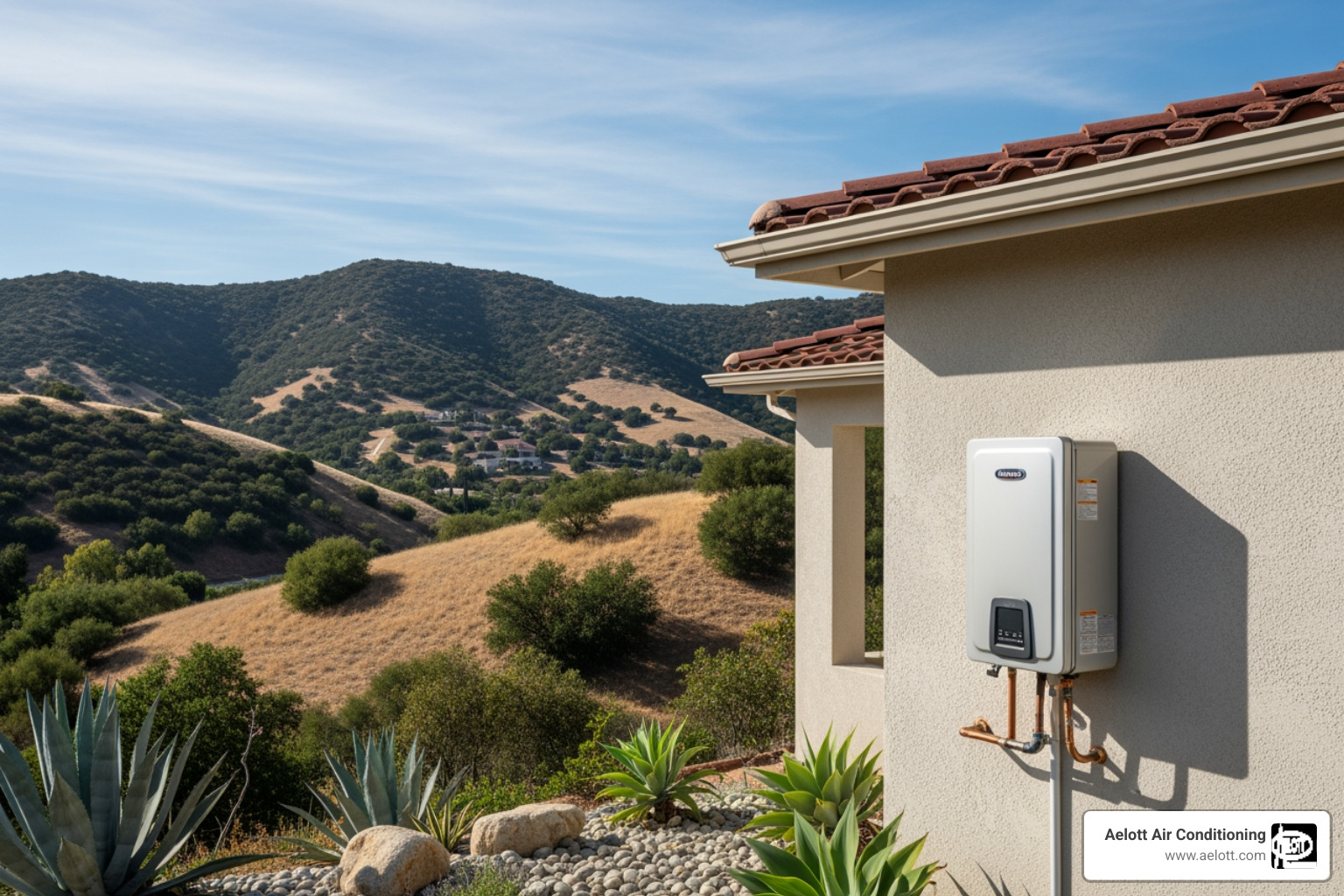
Why Valley Center Homeowners Are Making the Switch to Tankless
If you're considering a tankless water heater in valley center, ca, you're looking at a modern solution that heats water only when you need it, saves space, lasts longer than traditional tanks, and can reduce your energy bills by 24-34%. Tankless systems provide endless hot water on demand, making them ideal for families tired of running out during peak usage times or homeowners looking to reduce their environmental footprint.
Quick Overview: Tankless Water Heaters in Valley Center
- What they are: Compact units that heat water instantly as it flows through, no storage tank needed
- Key benefits: Endless hot water, 24-34% more energy efficient, 20+ year lifespan, space-saving design
- Best for: Homes with varying hot water demands, eco-conscious homeowners, properties with limited space
- Installation needs: Licensed contractor, possible gas line or electrical upgrades, California Title 24 compliance
- Common types: Gas or electric, whole-house or point-of-use (POU) models
For comprehensive guidance on water heating solutions, check out our water heater services, or if you're ready to explore your options, contact us for a consultation.
Living in Valley Center means enjoying wide-open spaces and a relaxed lifestyle, but when your morning shower turns cold halfway through or your water heater starts making strange noises, it disrupts everything. Traditional tank water heaters work hard, but they waste energy keeping 40-50 gallons of water hot around the clock, even when you're asleep or away. Tankless systems eliminate this standby heat loss by heating water only when you turn on the tap. Whether you're building new or retrofitting an existing home, understanding how tankless technology works and what it takes to install one in Valley Center will help you make a confident decision about upgrading your home's hot water system.
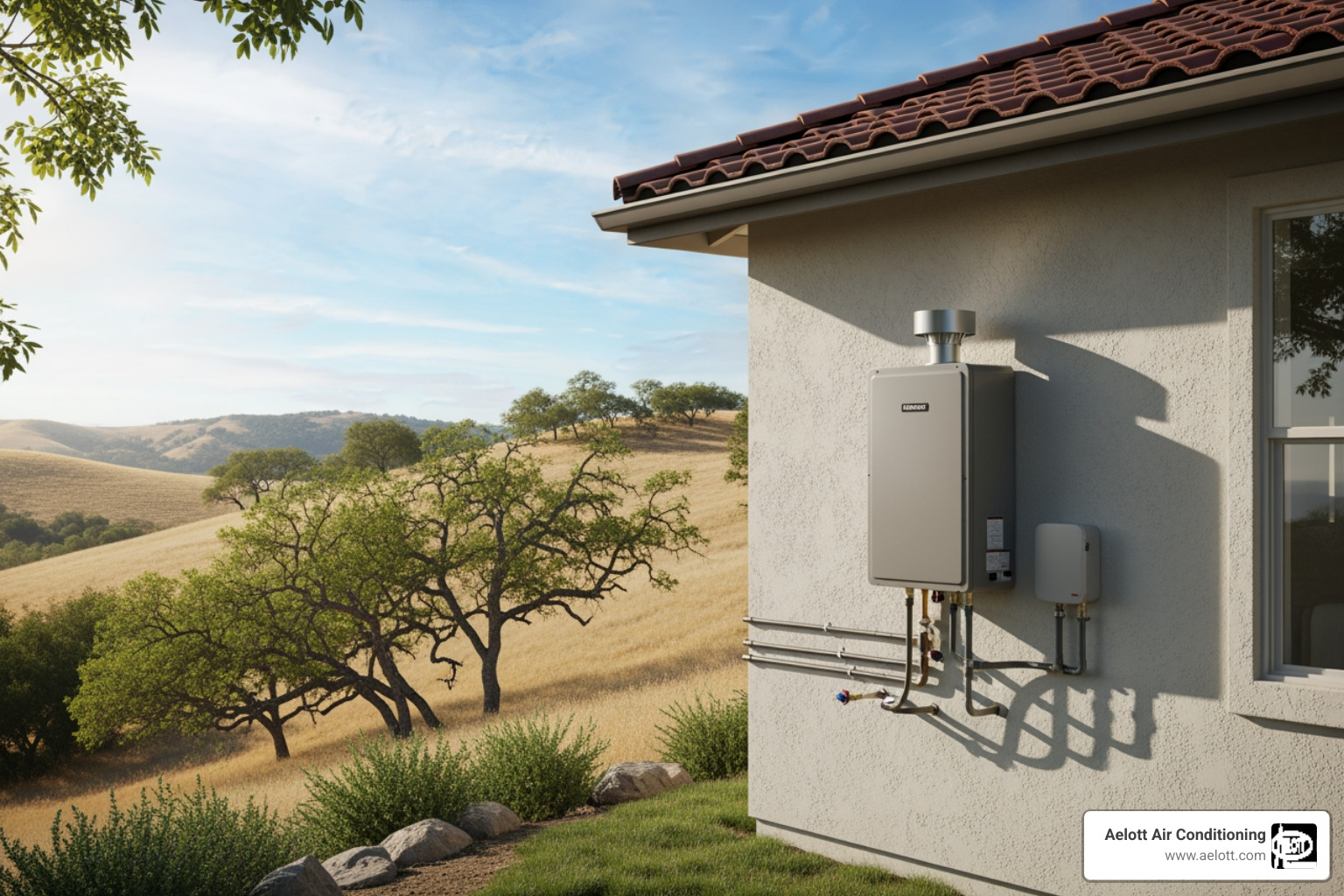
The Modern Upgrade: Why Valley Center Homes Benefit from Tankless Water Heaters
Valley Center residents are increasingly recognizing the undeniable advantages of tankless water heaters. These innovative systems offer a host of benefits that align perfectly with the desire for efficiency, comfort, and sustainability in our beautiful community.
First and foremost is energy efficiency. According to energy.gov, tankless water heaters are 24%–34% more energy efficient than conventional storage tank water heaters. This isn't just a number; it translates directly into savings on your utility bills. Traditional tank heaters constantly heat and reheat a large tank of water, leading to what we call "standby heat loss" – essentially, you're paying to keep water hot even when you're not using it. Tankless units, however, only activate when there's a demand for hot water, heating it on-the-fly. This "on-demand" approach means no wasted energy, just efficient heating precisely when you need it.
Then there's the luxury of endless hot water. Imagine never having to worry about cold showers again, even with a house full of guests or multiple appliances running simultaneously. Tankless systems provide a continuous supply of hot water, which is a game-changer for larger families or homes with high hot water demands.
Another significant benefit is their longer lifespan. While a traditional tank water heater typically lasts 10-15 years, tankless units are known to surpass this, often lasting 20 years or more with proper maintenance. This extended durability means less frequent replacements and greater long-term value for your home.
For many Valley Center homes, space-saving design is a huge plus. These compact units mount on a wall, freeing up valuable floor space that a bulky traditional tank would occupy. This can be particularly beneficial for smaller homes or those looking to optimize their utility areas.
Finally, tankless water heaters contribute to environmental sustainability. By heating water only when needed, they reduce overall energy consumption and, consequently, your home's carbon footprint. This aligns with California's broader goals for greenhouse gas reduction and energy efficiency, making them a smart choice for eco-conscious homeowners. When it's time for a water heater replacement, considering a tankless option is a step towards a more efficient and sustainable future.
Signs You Need a Water Heater Upgrade to a Tankless Water Heater in Valley Center, CA
How do you know it's time to part ways with your old water heater and accept the tankless revolution? Your current water heater often sends out subtle (or not-so-subtle) signals that it's nearing the end of its life or simply isn't performing optimally. Here are the key signs that a homeowner in Valley Center might need to consider a water heater replacement or upgrade to a tankless system:
- Aging Unit (10+ years): If your traditional tank water heater is a decade old or older, it's likely operating less efficiently and is more prone to failure. This is the prime age for considering an upgrade.
- Inconsistent Water Temperatures: Are your showers a game of hot-and-cold roulette? This often indicates your tank heater is struggling to maintain a consistent temperature or its capacity is being exceeded. Tankless units, with their on-demand heating, can provide more stable temperatures.
- Rusty or Discolored Water: If you notice rusty or discolored hot water coming from your taps, it's a strong indicator that the inside of your tank is corroding. This corrosion can lead to leaks and signifies that your unit is on its last legs.
- Strange Noises from Tank: Popping, rumbling, or banging noises from your water heater usually mean there's sediment buildup at the bottom of the tank. This sediment not only reduces efficiency but can also damage the tank over time.
- Leaks or Puddles: Any visible water around the base of your traditional water heater is a major red flag. Leaks can quickly lead to significant water damage and indicate a breach in the tank.
- Increasing Energy Bills: If your energy bills seem to be creeping up without a clear explanation, your inefficient water heater could be the culprit, especially if it's constantly working to heat water you're not even using.
If you're experiencing any of these issues, it's a good time to call us for a water heater repair assessment, and potentially discuss the benefits of upgrading to a tankless system.
New Construction vs. Retrofitting an Existing Home
The decision to install a tankless water heater can vary depending on whether you're building a new home or upgrading an existing one. Both scenarios present unique opportunities and considerations.
For new construction, installing a tankless water heater is often simpler and more cost-effective. You have the advantage of designing the home's plumbing and utility infrastructure around the tankless system from the ground up. This means easier planning for optimal placement, appropriate gas line sizing (gas tankless water heaters often require a larger gas line than traditional tanks, sometimes four to five times the typical BTU input), correct venting requirements, and dedicated electrical needs. Builders can integrate these systems seamlessly, ensuring maximum efficiency and performance from day one, and potentially qualifying for tax credits like the 45L tax credits for ENERGY STAR certified homes.
Retrofitting an existing home with a tankless water heater is absolutely doable and highly beneficial, but it does come with a few more considerations. Our experienced team will need to assess your current setup to determine what modifications might be necessary. Common retrofit considerations include:
- Gas Line Upgrades: As mentioned, gas tankless units demand a higher BTU input. Your existing gas line might be too small, requiring an upgrade to a larger diameter line to ensure sufficient fuel supply.
- Venting Requirements: Tankless water heaters need proper venting, which can be different from traditional tanks. Modern units often use PVC venting, offering flexibility, but the installation needs to meet local codes.
- Electrical Needs: Even gas tankless units require an electrical connection to power their ignition and control systems. Electric tankless units, of course, have much higher electrical demands. We'll ensure your electrical panel can support the new unit.
- Water Lines: The existing water lines will need to be connected to the new unit, and sometimes minor re-piping is needed for optimal flow.
- Location: While compact, tankless units still need appropriate placement, often on an exterior wall or in a utility closet, with adequate clearance for maintenance.
Regardless of whether it's a new build or an existing home, our team handles all aspects of water heater installation with professionalism and expertise, ensuring a smooth transition to your new, efficient hot water system.
Tank vs. Tankless: A Head-to-Head Comparison for Homeowners
When it comes to choosing a water heater for your Valley Center home, the debate between traditional tank models and modern tankless systems is a common one. Let's break down how they stack up against each other.
| Feature | Traditional Tank Water Heater | Tankless Water Heater |
|---|---|---|
| Efficiency | Lower (constant heating, standby heat loss) | Higher (24-34% more efficient, heats on demand) |
| Lifespan | 10-15 years | 20+ years |
| Hot Water Supply | Limited (tank capacity, can run out) | Endless (continuous supply) |
| Size | Large, bulky tank (takes up floor space) | Compact, wall-mounted (space-saving) |
The most significant difference lies in their operational method. Traditional tank water heaters store a large volume of hot water, typically 40-80 gallons, and keep it heated 24/7. This leads to standby energy loss, where energy is expended even when no hot water is being used. It's like keeping a pot of water boiling all day just in case you want tea.
Tankless water heaters, on the other hand, employ on-demand heating. When you open a hot water tap, cold water flows into the unit, where a powerful heat exchanger rapidly heats it to your desired temperature. This process eliminates standby heat loss, making them significantly more energy-efficient.
Performance is often measured in Gallons Per Minute (GPM). Tankless units can deliver a continuous flow of hot water at a specific GPM, meaning you won't run out. The exact GPM depends on the unit's size and the temperature rise required. For example, a unit might provide 8 GPM in a warmer climate but only 4 GPM in a colder one where the incoming water is much cooler. Our team can help you size the perfect tankless water heater for your home's specific needs, ensuring you get the endless hot water you expect.
Key Considerations for Installing a Tankless Water Heater in Valley Center, CA
Installing a tankless water heater in valley center, ca is a significant home improvement that requires careful planning and adherence to local regulations. We want to ensure your installation is safe, efficient, and compliant.
One of the most important aspects is understanding California Title 24 energy codes. These stringent standards, particularly the 2022 Title 24, Part 6 Building Energy Efficiency Standards, aim to reduce energy consumption and greenhouse gas emissions. For water heater alterations, Title 24 influences everything from pipe insulation to the type of recirculation systems allowed. For example, some gas instantaneous water heater installations (max input 200,000 Btu/h) are permitted in specific climate zones only if the space conditioning system is a heat pump. Our team is well-versed in these requirements and ensures your installation meets all state and local codes.
Speaking of codes, local permit requirements are crucial. A building permit is required for all water heater installations and replacements in California. Applying for a permit often involves submitting detailed plans, including site/floor plans, gas supply calculations, and specification sheets. These permits ensure that installations are done safely and correctly, protecting your home and your investment. We handle the permitting process for you, ensuring everything is in order. You can learn more about these regulations by checking our guide on water heater california code.
Always prioritize hiring licensed contractors. The California State License Board (CSLB) has helpful information on how to hire a contractor, verify license information, and review construction contracts. This is not just a recommendation; it's a necessity for complex installations like tankless water heaters, especially given potential gas line, electrical, and venting modifications. Our technicians are fully licensed, insured, and experienced in all aspects of tankless water heater installation.
Finally, sizing the unit correctly is paramount. This involves assessing your household's peak hot water demand—how many showers, dishwashers, and washing machines might run simultaneously. An undersized unit won't deliver the endless hot water you expect, while an oversized unit may not be the most efficient choice for your needs. We'll perform a thorough assessment to recommend the perfect tankless system for your family's needs.
Choosing the Right Type of Tankless Water Heater in Valley Center, CA
Not all tankless water heaters are created equal. Understanding the different types available will help you make an informed decision for your Valley Center home.
The primary distinction is between gas tankless heaters and electric tankless heaters:
- Gas Tankless Heaters: These are generally more powerful, offering higher flow rates (GPM) suitable for whole-house applications. They can be fueled by natural gas or propane. As noted earlier, they require a robust gas line and proper venting. Many modern gas units are condensing tankless water heaters, which are highly efficient because they capture heat from exhaust gases. Non-condensing models are also available but are less efficient.
- Electric Tankless Heaters: These units are often smaller and don't require gas lines or venting, making them easier to install in some locations. However, they typically have lower GPM outputs and often require significant electrical upgrades to your home's panel. They are often better suited for point-of-use applications or smaller homes with lower hot water demands. If you're experiencing issues with an electric unit, our guide on electric water heater problems might offer some insights.
Beyond the fuel source, you'll also consider:
- Whole-House Units: Designed to meet the hot water needs of your entire home, these are the most common type for tankless installations.
- Point-of-Use (POU) Heaters: These smaller units are installed directly at a specific fixture, like a bathroom sink or a distant shower, to provide instant hot water there. They are excellent for eliminating the wait for hot water at faraway taps or supplementing a main unit for high-demand areas.
Our team will help you evaluate your home's fuel type availability (natural gas lines are common in many parts of Valley Center, but propane might be used in more rural areas) and your hot water demands to recommend the most efficient and effective type of tankless water heater for your specific situation.
Common Problems and How to Address Them
While tankless water heaters are reliable, like any appliance, they can encounter issues. Understanding these common problems and how they're addressed can help you maintain your system and prolong its life.
- Mineral Buildup: This is perhaps the most common problem, especially in areas with hard water, like many parts of San Diego County. Hard water has a high mineral content (calcium and magnesium), which can accumulate on the heat exchanger. This "scaling" reduces efficiency and can restrict water flow. The primary solution is annual descaling or flushing the system with a vinegar or descaling solution. This proactive maintenance is crucial.
- System Overloading: If too many hot water fixtures are running simultaneously, the tankless unit might struggle to keep up, leading to a dip in water temperature or even a temporary shutdown. This often indicates the unit is undersized for the household's peak demand. Addressing this might involve adjusting hot water usage habits or, in some cases, installing a second tankless unit or point-of-use heaters for specific high-demand fixtures.
- Ignition or Flame Failure: For gas units, an ignition failure means the burner isn't lighting. This can be caused by issues with the gas supply (e.g., a low propane tank, an unpaid gas bill, or insufficient gas pressure), clogged ignition components, or faulty sensors. Flame failure occurs when the flame doesn't stay lit. Troubleshooting involves checking gas and water valve positions, ensuring adequate gas supply, and checking for error codes.
- Blocked Air Supply or Exhaust: Tankless units, especially gas models, need a clear path for combustion air intake and exhaust. Blockages (e.g., debris, insect nests, or improper venting) can lead to error codes and system shutdowns. Regular inspections and ensuring proper vent installation are key preventative measures.
The importance of regular maintenance cannot be overstated. Proactive care, particularly annual flushing, can prevent most of these issues and ensure your tankless water heater operates efficiently for its full lifespan. For more detailed troubleshooting, our tankless water heater repair guide is a valuable resource.
Frequently Asked Questions about Tankless Water Heaters
We often get asked a lot of great questions about tankless water heaters. Here are some of the most common inquiries from homeowners in Valley Center.
How long do tankless water heaters last compared to traditional ones?
This is where tankless systems really shine. A traditional tank water heater typically has a lifespan of about 10-15 years. This is largely due to the constant heating and cooling cycles, which can cause wear and tear, and the corrosive nature of water on the interior of the tank.
In contrast, a well-maintained tankless water heater can last 20 years or more. Some manufacturers even offer warranties extending up to 15 years on the heat exchanger, the heart of the unit. This extended durability is a significant advantage, meaning you'll replace your water heater less frequently, providing greater peace of mind in the long run. The key to achieving this longevity, however, is maintenance impact. Regular flushing and descaling, especially in areas with hard water, are crucial for reaching the upper end of that lifespan.
Do tankless water heaters really provide instant hot water?
This is a common misconception! While tankless water heaters provide endless hot water on demand, they don't necessarily provide instant hot water at the tap. Here's why: the unit heats water as it flows through it, but that heated water still needs to travel from the unit to your faucet or showerhead. The time it takes for hot water to reach your tap depends on the distance between the tankless unit and the fixture, just like with a traditional tank heater.
If "instant" hot water is a priority, you can achieve it by installing a recirculation pump with your tankless system. These pumps continuously circulate hot water through your pipes, ensuring that hot water is always available at your fixtures almost immediately. Without a recirculation pump, you might still experience a "cold water sandwich" effect, where a slug of cold water comes out before the hot water arrives, especially if the unit is far from the fixture. However, once the hot water arrives, it will continue to flow indefinitely.
What kind of maintenance does a tankless water heater require?
Regular maintenance is vital for ensuring your tankless water heater operates efficiently and lasts for decades. The most critical maintenance task is annual descaling, also known as flushing the system.
Here's what that involves:
- Flushing the System: Because Valley Center, like much of Southern California, has hard water, minerals can build up inside the heat exchanger. This scale buildup reduces efficiency and can damage the unit. Flushing involves closing off the water supply to the unit, connecting hoses, and circulating a descaling solution (often white vinegar) through the heat exchanger to dissolve mineral deposits.
- Hard Water Considerations: If your home has particularly hard water, we might recommend more frequent flushing or even installing a water softener to protect your tankless unit and other appliances.
- Inlet Screen Cleaning: Tankless units have a small filter, or inlet screen, where cold water enters the unit. This screen can sometimes catch sediment from your water supply. Cleaning this screen periodically ensures proper water flow.
We recommend professional maintenance annually to keep your tankless water heater in top condition. Our team is experienced in this specialized service, ensuring your unit continues to provide efficient, endless hot water. For a more detailed look at what this entails, you can refer to our tankless maintenance vista ca guide.
Conclusion: Your Next Step Towards Efficient Hot Water in Valley Center
Upgrading to a tankless water heater in valley center, ca is more than just replacing an appliance; it's an investment in your home's comfort, efficiency, and future. We've seen how these modern systems offer a continuous supply of hot water, significant energy savings (24-34% more efficient!), and a lifespan that far exceeds traditional tank models. Their compact design frees up space, and their energy-saving operation contributes to a more sustainable lifestyle.
The combination of an extended lifespan and unparalleled convenience makes it a smart choice for many Valley Center homeowners. Proper installation by a licensed professional and routine maintenance are key to open uping all these benefits.
For expert plumbing and tankless water heater services in valley center ca, trust the experienced team at Aelott Air Conditioning to ensure a professional installation. We're here to guide you through every step, from selecting the right unit to ensuring full compliance with local codes, so you can enjoy endless hot water and peace of mind for years to come.
Other Blogs

Customer Testimonials
Go With Experience

This company has been providing HVAC services to my family for over 40 years! We have a lot of confidence and trust in them. Receptionist is also very nice and responsive. Helps to be an established customer.

The technician, Terry, who came to our house was very professional. Answered all of our questions. Explain to us areas of concern. Provided us with solutions.
I had a great experience purchasing a new circuit board for my Carrier system. Doug was knowledgeable, friendly, and helpful and Aelott was able to help quickly and efficiently. Many thanks to the whole Aelott team!
The team goes a great job on servicing my 4 systems in our building. We did a remodel at my house and did a great job re-routing and re-balancing the systems. Highly recommend the company. For service or replacement.
Doug with Aelott was very polite and very knowledgeable. He explained the current status of my forced air ducts and it’s related equipment. I would highly recommend Aelott Heating and Air to others.

HVAC Financing Available!
Get 0% Financing for 12 Months with Deferred Interest! Enjoy no payments and no interest on select plans.


Latest Blogs

.avif)
How to Run Your Furnace Efficiently: A Guide to Staying Warm This Winter
